

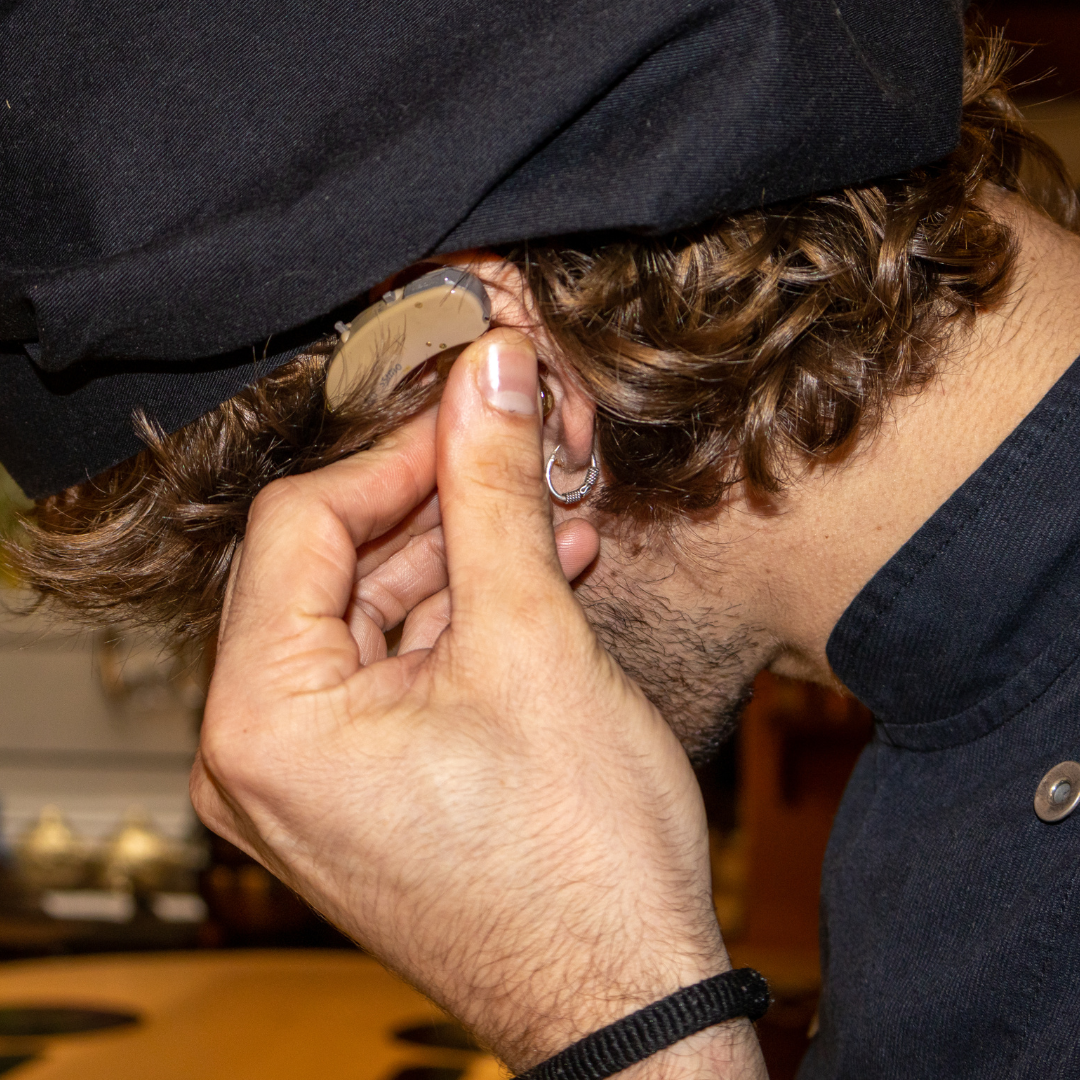
Group discussions in restaurants often become difficult to comprehend when room acoustics compete with your focus and hearing. Our audiology clinic conducts specialized testing to evaluate hearing in both quiet sound booths and noisy simulations to isolate the underlying cause. After diagnosing the source of your difficult hearing, we design targeted interventions tailored to your listening needs.
Explaining Normal Quiet Hearing Versus Restaurant Listening Fatigue
Quiet rooms provide a favorable signal-to-noise ratio, meaning a speaker’s voice is much clearer than the sounds around it. Modern restaurant environments create the complete opposite listening environment. Background voices, loud music, service clatter, and wall reflections collide with spoken words, demanding heightened cognitive processing to isolate individual speech.
Such listening challenges typically stem from high-frequency hearing loss, auditory-processing deficits, or accumulated noise-induced trauma. Visual limitations from low lighting, cognitive fatigue, and sitting farther away from conversational partners amplify speech degradation. Some people have normal results on a basic hearing test but still perform poorly on speech-in-noise testing. Difficulty in restaurants deserves evaluation even when everyday hearing seems normal.
Diagnostic Protocols for High-Frequency Hearing Loss
The diagnostic workup opens with an extensive intake examining difficult listening environments, past noise trauma, tinnitus presence, family history, and medical history.
Clinical pure-tone audiometry identifies hearing threshold levels across various frequencies by delivering sounds through air and bone pathways. High-frequency hearing loss commonly presents on the audiogram as a characteristic precipitous drop in the higher frequency ranges. Additional testing may include tympanometry to assess middle-ear function and word-recognition testing to measure speech understanding.
Because a quiet booth does not recreate a busy dining room, speech-in-noise testing can add valuable information. It evaluates sentence-level speech comprehension as competing background babble increases in volume. Collectively, these evaluations clarify if your challenges relate to raw audibility, phonetic clarity, signal-to-noise processing, or compound factors.
Auditory Processing Disorders: Impact on Adult Communication
An auditory processing disorder degrades the central nervous system’s capacity to organize and interpret complex sound inputs. While peripheral ears may register soft tones normally, the auditory cortex struggles to filter competing noise, resolve phonetic contrasts, or keep pace with rapid conversation. We systematically verify peripheral hearing health before establishing whether an advanced auditory-processing evaluation or medical referral serves your needs.
What Strategies Can Improve Hearing in Noisy Environments?
Simple situational adjustments enhance the speech signal entering your ears and offer clearer facial cues. Prior to dining, choose venues known for lower noise levels or schedule meals during quieter dining hours. Venues with booths, acoustic panels, curtains, carpeting, and other sound-absorbing features may be easier than open rooms filled with hard surfaces.
While seated at the restaurant:
- Reserve a table located well away from kitchen doors, active bar counters, overhead speakers, and banquet groups.
- Position yourself with your back toward a solid partition to dampen intrusive background noise from behind.
- Ensure you sit directly across from speaking partners in an area with sufficient illumination for visual lip-reading.
- Minimize the physical gap separating you and the person speaking as much as reasonably possible.
- Turn your better-hearing ear toward the specific speaker you want to hear most clearly.
- Request that companions rephrase misunderstandings using different words rather than repeating the same sentence.
- Clarify critical details explicitly instead of nodding along or pretending to catch the message.
- Excuse yourself for a momentary quiet pause when listening exhaustion starts to mount.
- Ask dinner guests to speak with clear enunciation at a steady, natural conversational rate.
- Shouting creates acoustic distortion that actively compromises speech understanding rather than helping.
Assistive Listening Technologies for Noisy Environments
The best technology depends on the cause of the difficulty, the listening environment, and whether hearing loss is present. Professionally fitted hearing aids may use directional microphones, digital noise reduction, and dedicated restaurant programs to emphasize speech from the front and reduce some competing sound. They still require realistic expectations because no device can remove every unwanted voice.
A remote microphone can provide a stronger improvement in the signal-to-noise ratio. The accessory is worn on the lapel or set near the speaker, streaming their voice directly into compatible hearing aids or wireless audio receivers. This strategy bypasses the detrimental effects of room reverberation, distance, and localized background chatter.
Additional effective assistive technologies include:
- Multi-directional table microphones designed for small dinner gatherings
- Telecoil components connecting directly to public hearing-loop systems
- Mobile device live-captioning programs and speech-to-text transcription software
- Earbuds or hearables with compatible assistive-listening features
- Sound-meter apps and acoustic dining directories for locating quiet venues
We can compare options, confirm compatibility, and teach you how to use the selected device.
The Clinical Role of Audiologists in Managing Loud Environments
A professional clinical assessment moves beyond basic baseline statements like “I hear fine in quiet rooms.” We examine the challenging acoustic venues, conversational setups, and noise profiles you encounter to select appropriate diagnostic tests. Your comprehensive workup may involve pure-tone hearing thresholds, middle-ear testing, recorded word recognition, and speech-in-noise measures. Specialized auditory-processing testing can be ordered when patient history and preliminary audiometric findings warrant deeper neural investigation.
Any sudden, asymmetric, or rapidly deteriorating hearing loss demands immediate medical evaluation by an ear, nose, and throat physician. Personalized care identifies the source of the difficulty rather than assuming restaurant noise is the only problem.
Request an Audiology and Hearing Evaluation Today
If struggling through dinner conversation leaves you mentally exhausted, detached, or constantly guessing, schedule a complete hearing evaluation with our clinic. We provide proven treatments to enhance your hearing in noisy environments, offering hearing aid fine-tuning, specialized assistive accessories, and individualized auditory therapy.
Connect with us today to arrange your clinical visit and take the first step toward clearer, easier dining communication.